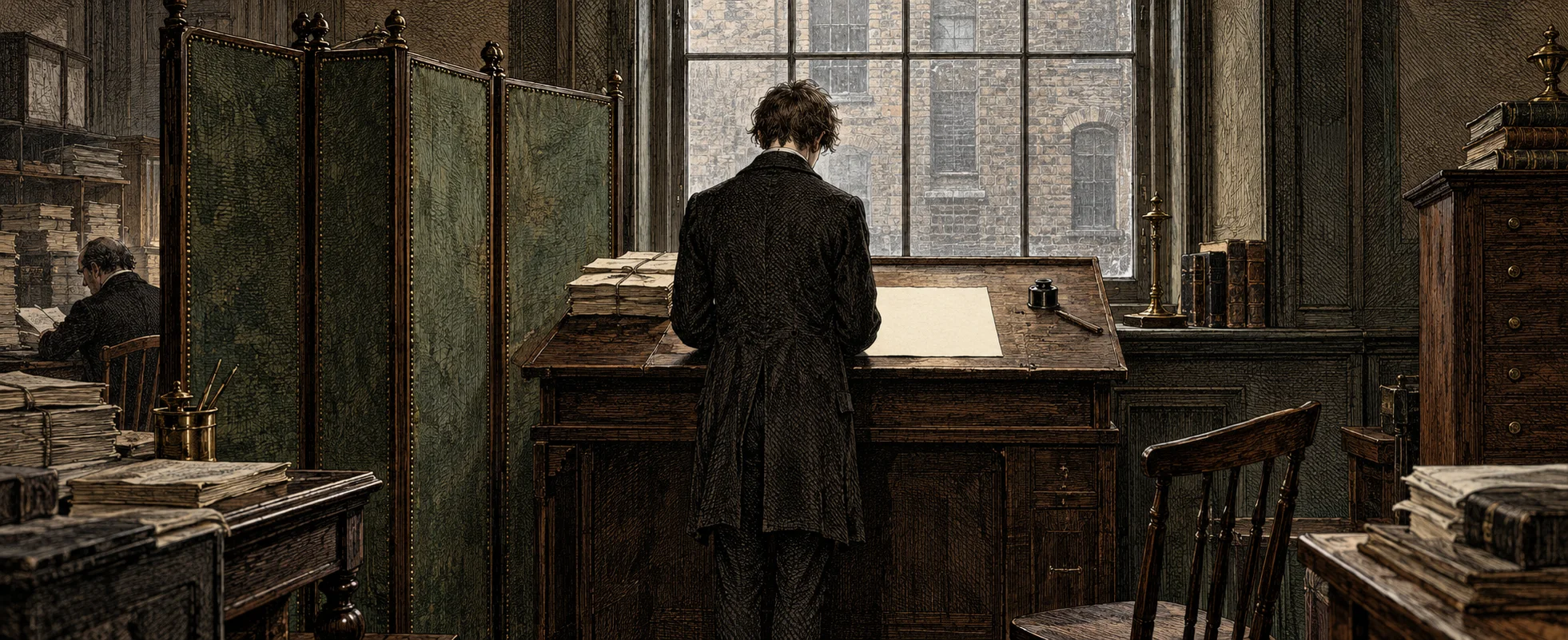
Original artwork, not a still
Bartleby, the Scrivener ‧ 1853
I would prefer not to.
Behind the line
What it means
Our interpretation.
Not a refusal, not quite a yes: the grammar is what makes it unsettling. Bartleby never gives a reason and never raises his voice, and the polite phrasing leaves his employer with nothing to argue against. That is why it became shorthand for passive resistance, quoted by philosophers and office workers alike, and why the Economist named its management column Bartleby.
Context reviewed
In context
Spoilers for Bartleby, the ScrivenerShow the scene
In Herman Melville's short story, first serialized anonymously in Putnam's Magazine in November and December 1853, a Wall Street lawyer takes on a new copyist, Bartleby. After a first burst of excellent work, Bartleby is asked to help proofread a document and answers with this line. It becomes his reply to every request, and he does less and less until he does nothing, staring out at a brick wall. The lawyer moves his office to escape him. Bartleby ends in the Tombs prison, where he is found dead, having preferred not to eat.
Sources (1)
- Wikipedia: Bartleby, the Scrivenerlead, Plot, In popular cultureReference checked
Context reviewed