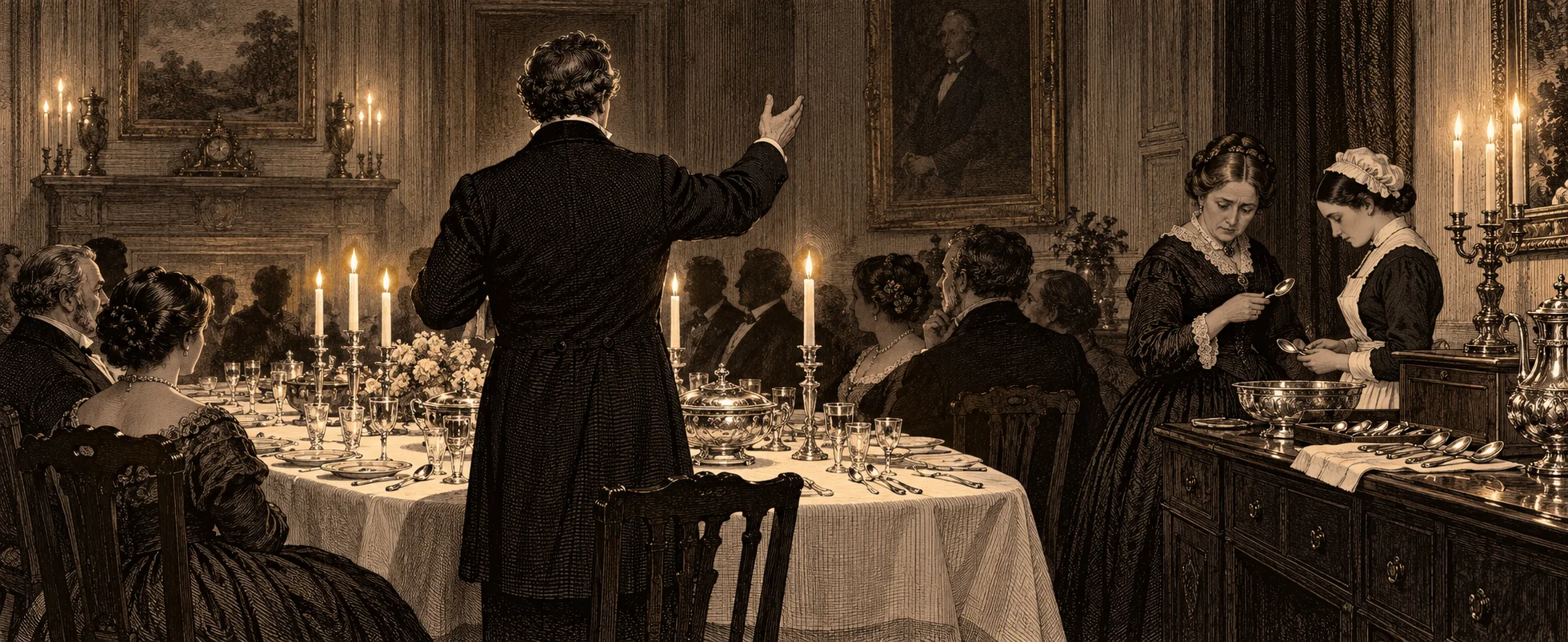
Original artwork, not a still
The Conduct of Life ‧ 1860
The louder he talked of his honor, the faster we counted our spoons.
Behind the line
What it means
Our interpretation.
It is a proverb for the gap between boasting and behaviour: the more someone insists on their integrity, the more reason you have to check your pockets. Emerson's own target was bigger than one shifty neighbour, since the passage goes on to the public cheat who earns respect, but the spoons are what stuck. Today it is the standard reply to any politician or salesman who protests too much.
Context reviewed
In context
Spoilers for The Conduct of LifeShow the scene
The sentence comes from "Worship", the sixth essay in Ralph Waldo Emerson's The Conduct of Life (1860). Emerson is arguing that society punishes small, private crooks while fawning over big public ones. A pickpocket who slips into a gathering of gentlemen is shown the door, he says, but a man who gets himself elected senator or president by the same tricks is given dinners and ovations. He then looks back at the plain thief: nobody was fooled by his talk, for the louder he spoke of his honor, the faster the household counted its spoons.
Sources (4)
- Emerson, The Conduct of Life, "Worship" (Project Gutenberg text, 1871 printing)essay VI, Worship, the passage on the pickpocket, the adventurer and the public sinnerReference checked
- Wikipedia, The Conduct of LifeintroReference checked
- Wikiquote, Ralph Waldo EmersonThe Conduct of Life (1860), WorshipReference checked
- Project Gutenberg: The Conduct of LifeEssay VI, WorshipReference checked
Context reviewed