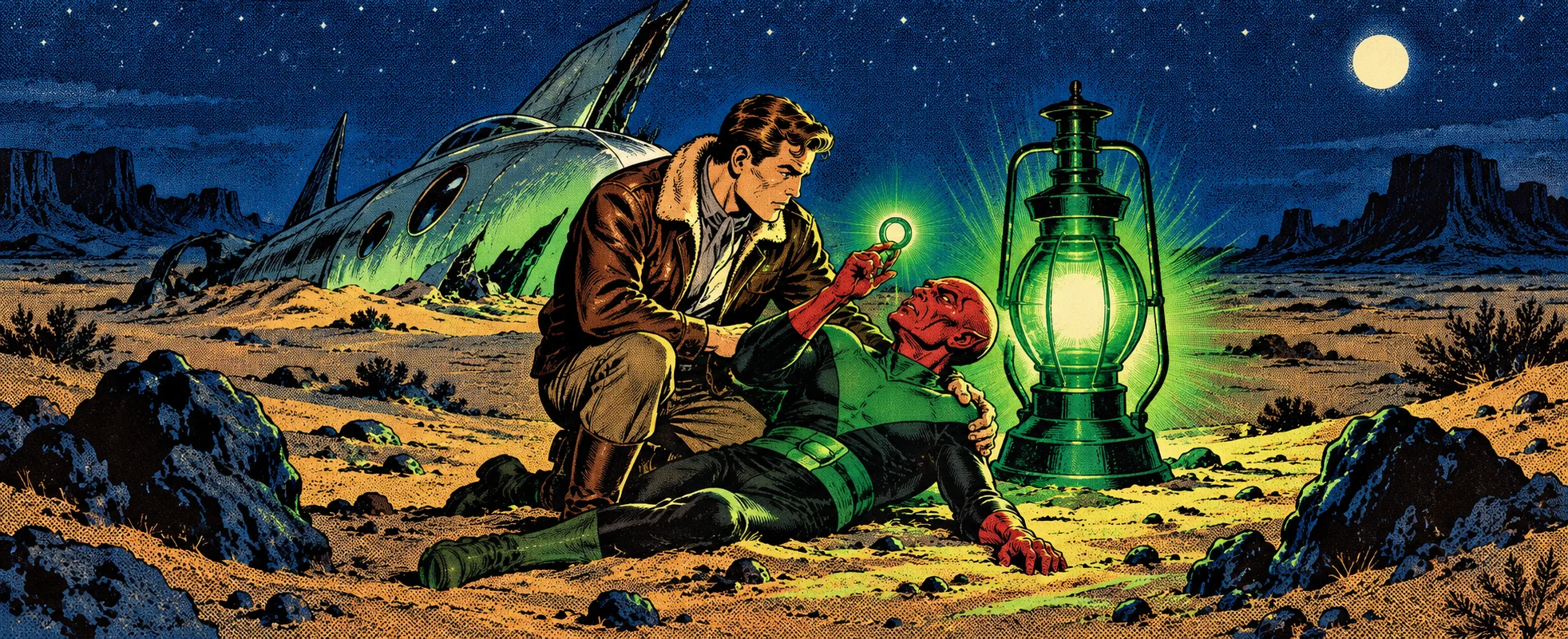
Original artwork, not a still
In brightest day, in blackest night, / No evil shall escape my sight. / Let those who worship evil's might / Beware my power... Green Lantern's light!
— Green Lantern · 1959
Behind the line
What it means
Our interpretation.
It reads like a nursery rhyme with a badge: four lines a child can memorise, ending on the hero's name so it works as both promise and signature. Each writer who takes up the ring tweaks it, and the tweaks became a way of showing who a Lantern is. The one that entered the language is "blackest night", which grew into a whole crossover and its sequel, Brightest Day.
Context reviewed
In context
Spoilers for Green LanternShow the scene
The oath is what a Green Lantern says while recharging the power ring, and it is older than Hal Jordan. Writer Alfred Bester gave it to the original Green Lantern, Alan Scott, in issue #9 of his comic in fall 1943, with the rhyme "in brightest day, in darkest night". When DC reinvented the hero, Hal Jordan, a test pilot who is handed a ring by a dying alien, debuted in Showcase #22 in October 1959, and the oath was revived for him. The "blackest night" wording in this line is the common variant, and it later gave the 2009 event Blackest Night its name.
Sources (3)
- Wikipedia: Green LanternGreen Lantern Oath sectionReference checked
- Wikipedia: Green Lantern CorpsOaths sectionReference checked
- Wikipedia: Hal JordanLead and publication historyReference checked
Context reviewed