Original artwork, not a still
I cannot believe that God plays dice with the cosmos.
Behind the line
What it means
Our interpretation.
For Einstein it was not a statement about religion but about physics: he could not accept that nature's deepest level was chance, and he spent decades looking for a fuller theory underneath. Bohr's reputed answer, that Einstein should stop telling God what to do, gave the quarrel a second famous line. The sentence now stands for any scientist doubting the odds, and it has crossed into fiction and everyday talk as a way to say that the universe is not random.
Context reviewed
In context
May contain spoilersShow the scene
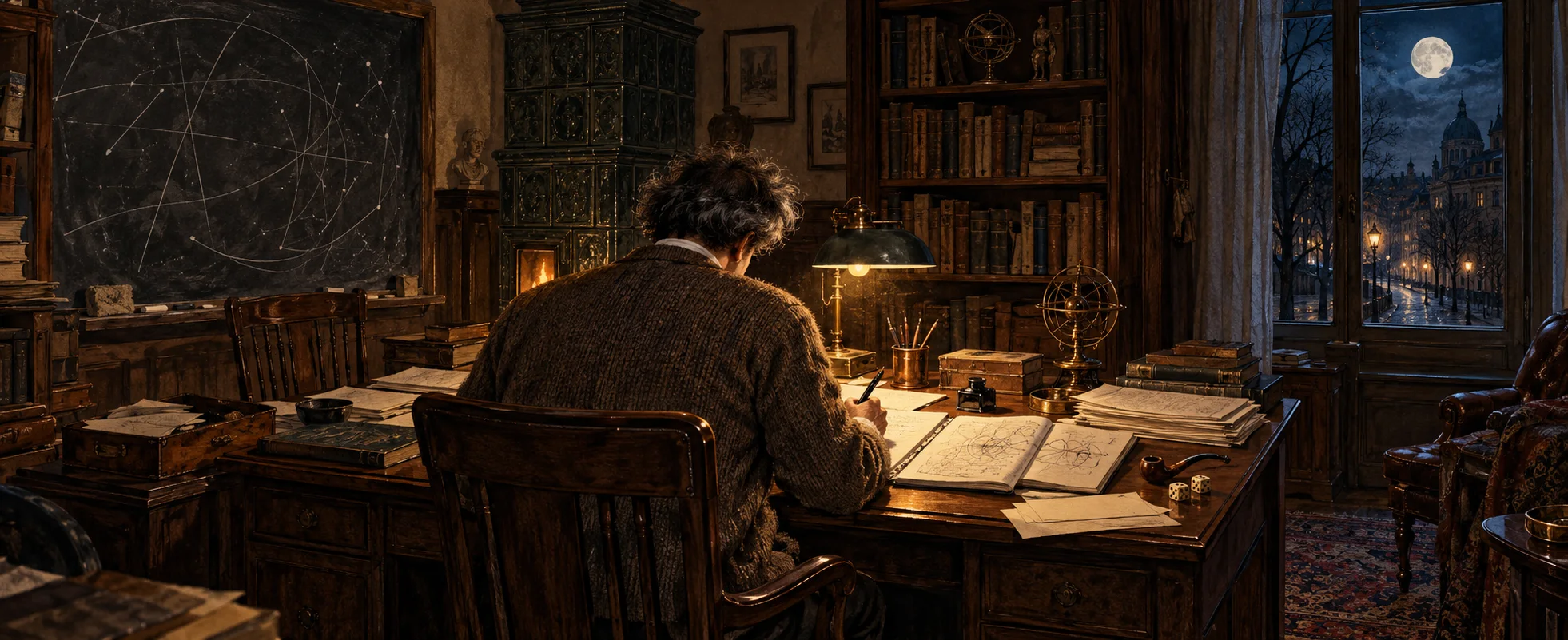
The sentence is Einstein's best-known objection to quantum mechanics. In 1926 Max Born published the probabilistic reading of the wave function, in which an individual collision has no cause that fixes its outcome. Einstein replied to Born in a letter of 4 December 1926 that the theory said a lot but did not bring him closer to the secret of the 'old one', and that he was convinced 'He does not throw dice'. He kept using variants for the rest of his life, including in a 1943 conversation recorded by William Hermanns. The wording on the site, about God and the cosmos, is a looser popular paraphrase.
Sources (2)
- Albert Einstein, WikiquoteLetter to Max Born (4 December 1926) and the note on variantsReference checked
- God does not play dice, WikipediaHistory sectionReference checked
Context reviewed