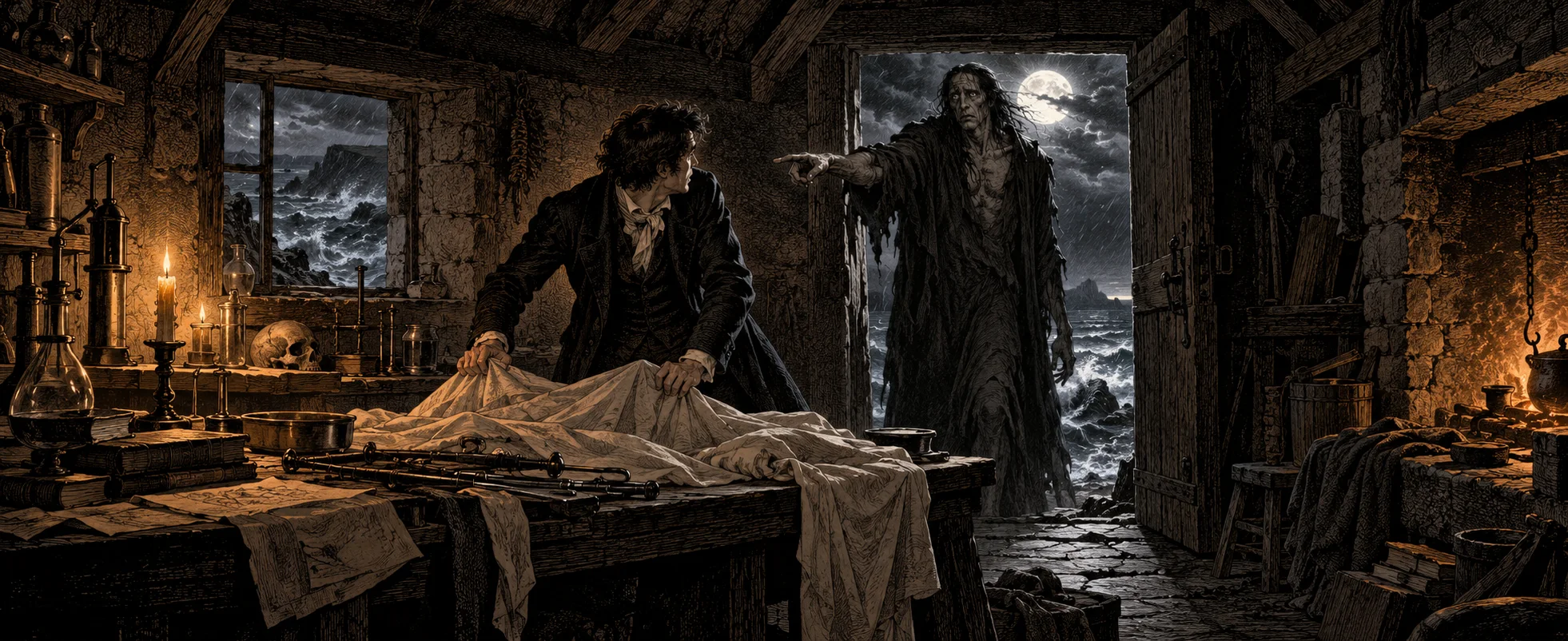
Original artwork, not a still
Frankenstein ‧ 1818
Nothing is so painful to the human mind as a great and sudden change.
Behind the line
What it means
Our interpretation.
Grief is rarely a single cry; here it is the shock of a world that goes on looking ordinary. Shelley gives Victor a plain, almost clinical observation, and that restraint is why the line travels so well. Readers quote it for any abrupt upheaval, a bereavement, a firing, a diagnosis, long after the novel's gothic machinery has faded from memory.
Context reviewed
In context
Spoilers for FrankensteinShow the scene
Victor Frankenstein is rowing across Lake Geneva at dawn, racing home after the murder of his wife Elizabeth on their wedding night, in the 1818 text's Volume III, chapter 6 (chapter 23 in the continuous numbering). The rain has just stopped, and he sees fish playing in the water exactly as they had the evening before, when Elizabeth watched them with him. He sums up his state in this line: the world looks unchanged, yet nothing can appear to him as it did a day earlier. Victor is telling the story to Walton, and goes on to say he has reached the peak of his tale of horrors.
Sources (1)
- Frankenstein; or, the Modern Prometheus (1818 text), Project Gutenberg #84Chapter 23 (Vol. III, ch. 6), the lake crossing after Elizabeth's deathReference checked
Context reviewed