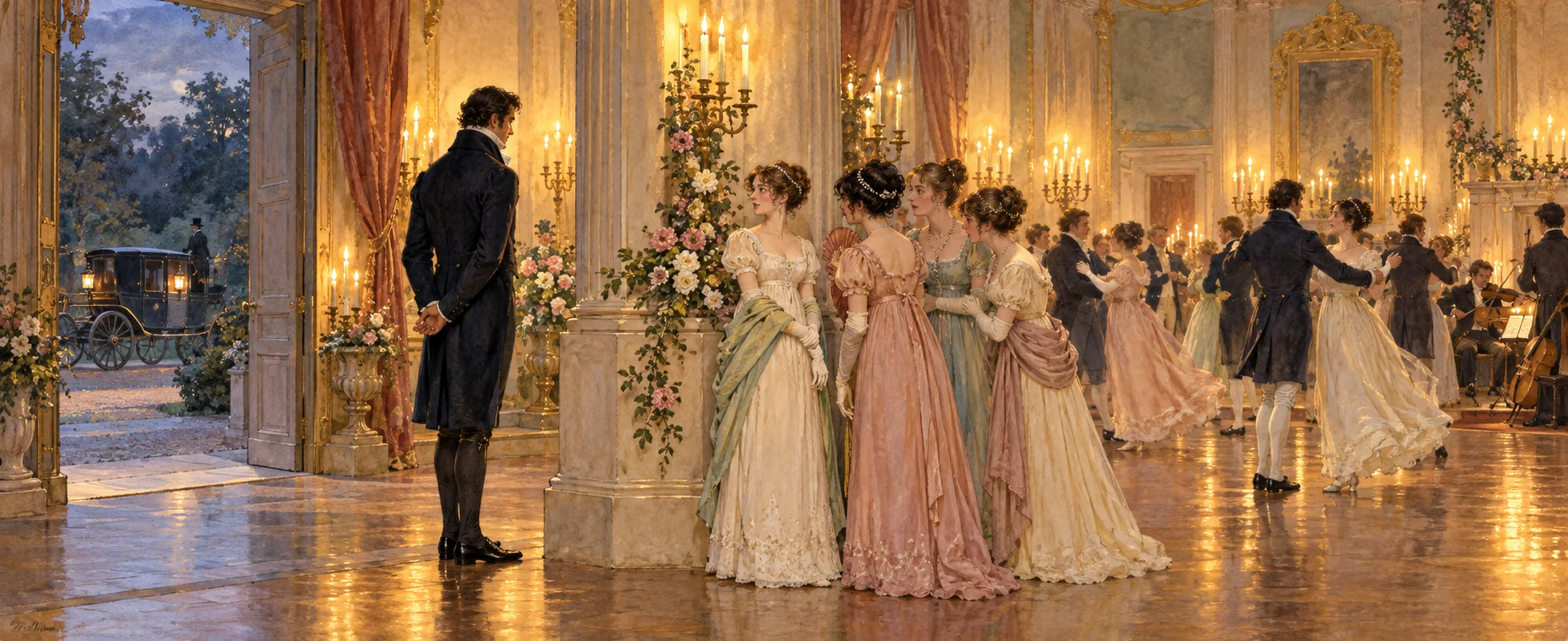
Original artwork, not a still
Pride and Prejudice ‧ 1813
It is a truth universally acknowledged, that a single man in possession of a good fortune must be in want of a wife.
Behind the line
What it means
Our interpretation.
Austen's irony is built into the grammar: the 'truth' is not about the man's needs at all but about the neighbourhood's, since it is the families with daughters who want him wed. The sentence is probably the most imitated opening in English, endlessly parodied and reworked by later novelists, and 'a truth universally acknowledged' is now a ready-made frame for any wry generalisation.
Context reviewed
In context
Spoilers for Pride and PrejudiceShow the scene
These are the opening words of Pride and Prejudice, first published in three volumes by T. Egerton of Whitehall on 28 January 1813; Austen's working title was First Impressions. Chapter 1 sets the book going in Hertfordshire. The narrator states the 'truth', then explains that a newcomer to a neighbourhood is at once regarded as the rightful property of one of the local daughters. Mr and Mrs Bennet's talk of a rich young man renting Netherfield, Mr Bingley, follows, and Mrs Bennet's business in life is to get her five daughters married.
Sources (2)
- Pride and Prejudice (Wikipedia)Infobox and PlotReference checked
- Pride and Prejudice on WikiquoteChapters 1-10, Ch. 1Reference checked
Context reviewed