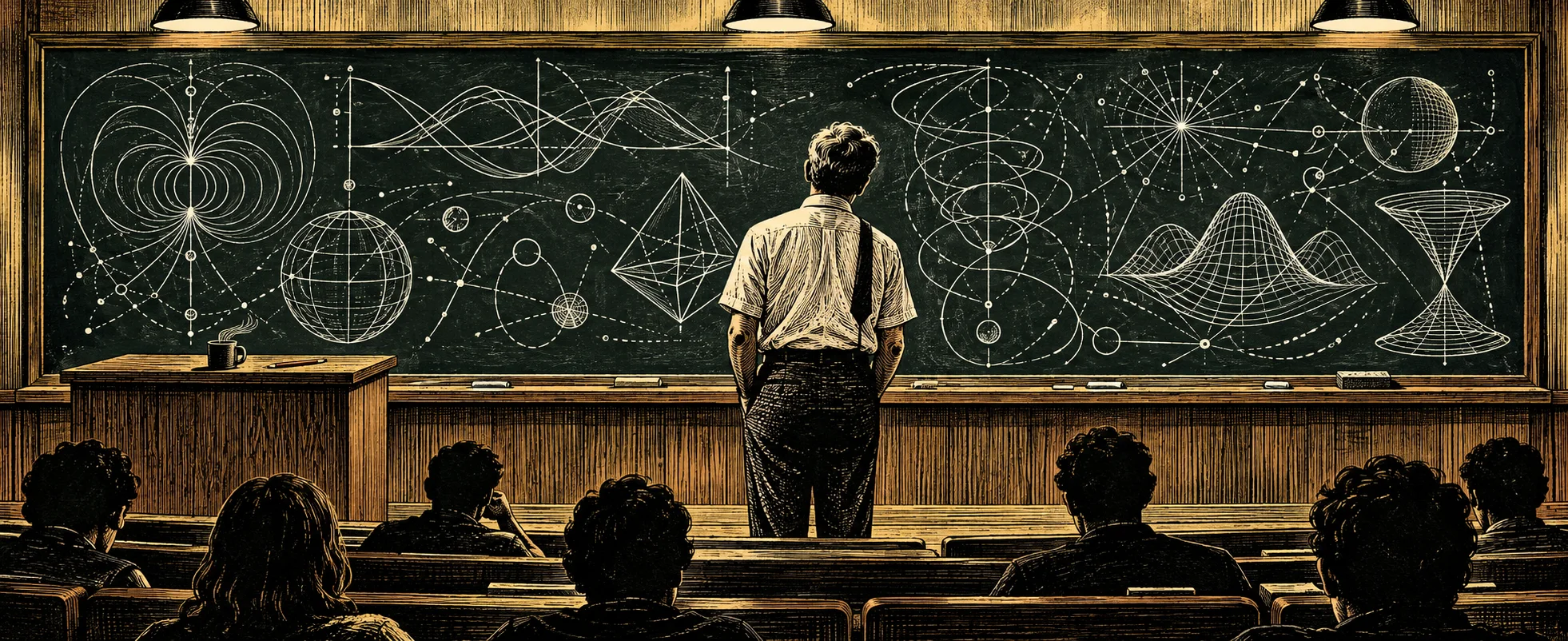
Original artwork, not a still
I can live with doubt and uncertainty and not knowing. I think it is much more interesting to live not knowing than to have answers that might be wrong.
Behind the line
What it means
Our interpretation.
Coming from a Nobel laureate, it is permission to say 'I don't know' without shame, and it turns uncertainty from a failure into the fun part of science. Teachers, scientists and anyone fed up with false confidence quote it. It is also the line fans reach for when someone demands a firm answer to a question that does not have one, and it fits Feynman's wider habit of puncturing authority with curiosity.
Context reviewed
In context
May contain spoilersShow the scene
The words come from a 1981 interview with the physicist Richard Feynman for the BBC television series Horizon, in the documentary titled "The Pleasure of Finding Things Out". Speaking about what science has and has not taught him, he says he can live with doubt, uncertainty and not knowing, and finds it more interesting than answers that might be wrong. He goes on to say he has approximate answers and different degrees of certainty about different things, but is not absolutely sure of anything, and that being lost in a universe without an obvious purpose does not frighten him. The interview was later printed in Christopher Sykes's 1994 book No Ordinary Genius.
Sources (1)
- Wikiquote: Richard FeynmanNo Ordinary Genius (1994) section, p. 239, interview in The Pleasure of Finding Things Out (1981)Reference checked
Context reviewed